

Your toddler sits on the floor surrounded by toys, and they pick things up one at a time — a block, a peg, a carrot — examining each in isolation before discarding it for the next. They interact with objects, but they don't yet organize them. Because the cognitive operation that allows a child to see a pile of mixed items and mentally distribute them into groups — by color, by shape, by size, by function — is not instinctive. It is learned. And it is learned through the specific kind of hands-on practice that requires the child to actively place an item into a category, see whether it fits or doesn't, and adjust. This operation is called categorical thinking, and it is the single most underrated cognitive skill in early childhood. It is the skill that allows a child to understand that a red circle and a blue circle belong to the same category (shape) while a red circle and a red square belong to a different one (color). It is the skill that underpins letter recognition (grouping symbols by type), number sense (grouping quantities by equivalence), and every form of logical reasoning your child will ever use. It does not develop from flashcards or videos. It develops from the physical, repetitive act of sorting real objects with real hands.

Montessori 6-in-1 Sorting Tool
€58,95
Angebotspreis
€58,95
Normaler Preis
Zu Produktinformationen springen


Montessori 6-in-1 Sorting Tool
€58,95
Normaler Preis
Angebotspreis
€58,95
Product Details:
- Age: 1+
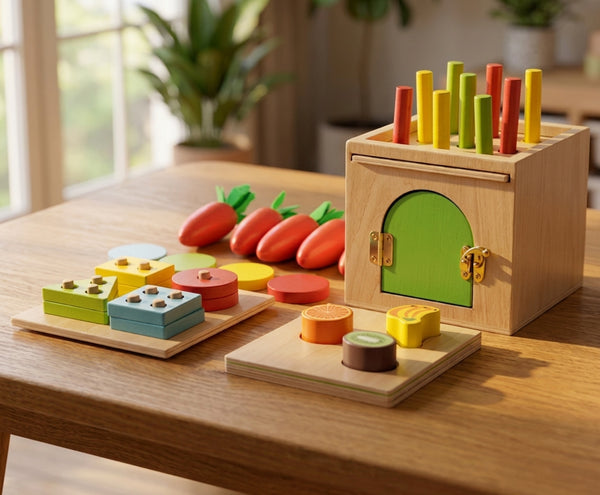
- Contains: (1) wooden box, (5) shape sorters, (29) sorting pieces
- Size: 5.1" x 4.8" x 4.8" (13cm x 12.3cm x 12.3cm)
- Weight: 1lb 13.6oz (840g)
- Material: high-quality, eco-friendly wood
- Care: Clean with a dry or damp cloth. Avoid prolonged contact with liquids.

Montessori 6-in-1 Sorting Tool — Master Foundational Categorical Thinking Beyond Basic Object Play

Six Differentiated Game Modules Train Full-Dimensional Categorization Logic
The Montessori 6-in-1 Sorting Tool is built to give this cognitive operation six different surfaces to practice on. Not six random activities thrown together to inflate a feature list — six sorting operations that each train a different dimension of categorical thinking. The peg board with its colored cylinders teaches insertion and color-matched placement: each peg belongs in a specific hole, and the wrong color simply doesn't fit the pattern. The stacking blocks with their bumpy surfaces teach size-progressive nesting: each layer must be placed in sequence, and the wrong size visibly breaks the order. The carrot pull set teaches extraction and reinsertion by matching: pull the carrots out, mix them up, and your child must sort them back into their holes by size, reinforcing that objects belong to categories and those categories have rules. The color-sorting discs teach pure classification without spatial constraints: group by color, group by shade, group by size — the same objects, different sorting logics, training the brain to switch between category dimensions. The shape-matching blocks teach form-based categorization: recognizing that a square peg and a round peg belong to fundamentally different groups regardless of color. And the nested cylinders teach seriation — the most advanced form of sorting, where items must be ordered along a continuous dimension from smallest to largest.

Multi-Logic Sorting Practice Cultivates Core Dimensional Switching & Cognitive Flexibility
Six activities, one cognitive thread. The reason this matters is that a child who only practices one form of sorting — colors, for example — becomes competent at sorting by color but not at sorting itself. The ability to flexibly shift between category dimensions (sort these by shape, now sort the same items by color) is called dimensional switching, and it is a core component of cognitive flexibility. Research in developmental psychology shows that children who practice multiple categorization tasks outperform those who practice a single task, not because they know more categories, but because their brains have learned the meta-skill: how to decide which dimension matters in a given moment (Sloutsky, 2010; Kloos & Sloutsky, 2008). The 6-in-1 Sorting Tool trains this meta-skill by design. Each activity presents a different sorting logic, and the child who moves between them throughout a play session is practicing the most important part of categorical thinking — not the sorting itself, but the decision about how to sort.

Progressive Iterative Play Builds Long-Term Logical Reasoning & Learning Competence
This all-in-one sorting toy adopts a progressive cognitive training system, covering basic color and shape matching, intermediate size classification and nesting, to advanced seriation and dimensional switching. Every gameplay delivers targeted cognitive stimulation, guiding children to gradually upgrade from simple object recognition to independent logical classification. Continuous hands-on sorting practice helps children internalize core classification rules, develop orderly thinking habits, and master the ability to analyze object attributes, distinguish dimensional differences and judge category affiliation. These cultivated categorical thinking skills lay an irreplaceable foundation for future letter recognition, number sense, mathematical classification and multi-dimensional logical reasoning, becoming the core underlying ability for long-term academic learning.

Premium Solid Wood Build Delivers Pure Screen-Free Hands-On Cognitive Training
Crafted from high-quality solid wood with non-toxic water-based paint and smooth rounded edges, every component is finely polished to fit toddlers’ small hands for safe and comfortable independent operation. The sturdy structure supports long-term repeated sorting, inserting, nesting and pulling play without easy wear and tear. No batteries, no screens, no sounds, and no electronic overstimulation. It provides pure child-led Montessori sensory and cognitive play, allowing children to acquire core logical thinking abilities through tangible physical operation. Far beyond ordinary single-function sorting toys, this 6-in-1 integrated set systematically trains children’s cognitive flexibility, dimensional judgment and independent problem-solving skills, organizing and optimizing all of their early learning abilities through one foundational cognitive skill.
Shop The Full Collection